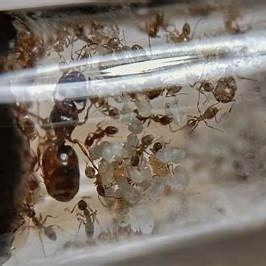
Understanding ant colony growth stages helps you support a queen from capture to a thriving colony. This guide explains each ant colony growth stage (founding, nanitic, growth, mature), gives clear feeding and environment tips for Australian species, and flags when to upgrade your setup.
Contents
- Quick timeline & one-line summary
- 1. Founding stage
- 2. Nanitic stage
- 3. Growth phase
- 4. Mature colony
- Species-specific notes
- Quick reference feeding table
- Recommended visuals
- FAQ
Quick timeline & one-line summary
| Stage | Typical timeframe | Top actions | Signs to change care |
|---|---|---|---|
| Founding | 0–4–8 weeks | Quiet test-tube, monitor moisture & temperature | No eggs after 4 weeks; mould; queen very restless |
| Nanitic | 4–12 weeks | Introduce small regular sugar & protein; low disturbance | Food ignored; constant brood moves; high mortality |
| Growth | 3–12 months | Scale food and space; consider a starter formicarium | Overcrowding in tube; frequent brood shifting; >25–50 workers |
| Mature | 1+ years | Stable feeders, nest expansion, prepare for alates | Winged alates; large foraging trails; colony >200+ (species dep.) |

1. The Founding Stage (0–8 weeks)
👑 The queen’s survival test — this is the most fragile ant colony growth stage. Many queens will succeed with a quiet test-tube setup and minimal interference.
What happens
- The queen digs a chamber and begins laying eggs (often within 1–2 weeks).
- Fully claustral queens (many Camponotus, some Pheidole and Iridomyrmex) use body reserves and won’t accept food.
- Semi-claustral queens (many Myrmecia and Rhytidoponera) forage early and need tiny amounts of food.
- Pupae form and nanitic workers typically emerge in ~4–8 weeks.
Environment (temperature & humidity)
- General Australian range: 20–28°C, stable day-to-day. Avoid large swings.
- Myrmecia & Rhytidoponera: often do well slightly cooler/drier (≈18–25°C, 30–50% RH).
- Iridomyrmex, Pheidole, Camponotus: 22–28°C, moderate humidity (40–60%).
- In a test tube, keep the water reservoir moist but not flooded; cotton should prevent pooling and reduce mould risk.
Feeding (concrete)
- Fully claustral queens: do not feed — offering food can stress or cause egg-eating.
- Semi-claustral queens: a tiny 1–2 mm dab of honey or 1–2 drops of 1:1 sugar water every 2–3 days; one very small protein item (tiny fruit fly or a cricket fragment) about once a week.
- Always present food outside the sleeping chamber (tube entrance on foil or small dish) to lower mould risk.
Need a visual guide for a proper test-tube setup? See our step-by-step Test Tube Setup for Queen Ants.
Troubleshooting — Founding
- No eggs after 3–4 weeks: check temperature and moisture; if the tube is fine the queen may be immature, stressed or injured.
- Mould in the tube: replace the setup quickly — carefully transfer the queen to a fresh tube (see test-tube guide above).
- Queen eating eggs: reduce disturbances and recheck humidity/temperature.
2. The Nanitic Stage (≈4–12 weeks)
🐜 Nanitics are tiny first-generation workers that take over brood care—this is the first big shift in ant colony growth stages.
What happens
- Nanitics forage, clean, and allow the queen to focus on laying.
- The colony’s food demand rises quickly.
- Workers may be paler and shorter-lived, but essential for colony momentum.
Feeding — quantities & frequency
- Sugar: 1–3 drops of 1:1 sugar water (or a tiny smear of honey) daily or every second day for a small group (5–20 workers).
- Protein: 1–3 tiny prey items (fruit flies, small moths, half a cricket leg) every 2–3 days. Increase as larvae numbers grow.
- If you want more background on feeding choices and recipes, check The Ultimate Ant Feeding Guide.
Behavioural cues — when to worry
- Ignoring protein: offer smaller prey or leave the food longer; sometimes groups need time to accept new items.
- Frequent brood transfers: stabilise humidity and reduce disturbances.
- High nanitic mortality: check for mould, contaminated food, or sudden temperature issues.
Troubleshooting — Nanitic
- Food moulds quickly: move it further out, reduce portions or use freeze-dried protein temporarily.
- Workers not foraging: dim lights, ensure the tube entrance is visible and stop handling for 24–48 hours before offering food.
3. Growth Phase (3–12 months)
📈 This ant colony growth stage is about scaling: more workers, emerging castes (in some species), and rising demands for space and food.
What happens
- Worker numbers increase quickly; caste differences (minor/major) appear in genera like Pheidole.
- Organised foraging and trails develop; brood care becomes efficient.
- Humidity and nest space needs grow with population.
Feeding — scale up
- Sugar: multiple drops or a small vial feeder daily for colonies of 30–200 workers.
- Protein: daily or every second day depending on larvae load — several small prey items per feed for medium colonies.
- Rotate natural prey with commercial gels; avoid stale/rotting items.
Upgrade triggers — when to leave the test tube
- Worker count: many keepers upgrade at ~25–50 workers (species-dependent).
- Behavioural cues: constant brood transfers, workers clustering outside the tube, or foragers unable to return because of overcrowding.
- Drying test tube or unstable microclimate: time to move to a controlled nest.
If you’re ready to expand, our Formicarium Upgrade Guide walks through when and how to move a founding colony safely.
Troubleshooting — Growth
- Brood constantly moved: increase humidity slightly and offer larger nesting cavities.
- Many dying larvae: check for contaminated food, mites or rapid temperature swings.
- Escapes during transfers: move in the evening and use distraction food to draw foragers away.
4. The Mature Colony (1+ years)
🏰 In this final ant colony growth stage the colony often has hundreds of workers, clear division of labour, and may produce alates or split into multiple nests (species-dependent).
What happens
- Castes and division of labour are established; foraging trails may be extensive.
- Alates may appear seasonally—this is a sign of reproductive maturity for many species.
- Some species accept polygyny; others remain strictly monogynous.
Care & feeding for large colonies
- Continuous sugar sources (feeder or reservoir) and daily protein if many larvae are present.
- Monitor seasonal changes — many species slow in winter and need less food.
- Keep feeding areas clean to prevent pests and contamination.
When to create outworlds or expand nests
- Large foraging trails, alates present, or workers constantly outside the nest are good reasons to expand.
- Plan secure containment and extra foraging area (outworld) if you expect alates or large numbers of foragers.
Troubleshooting — Mature
- Sudden crashes: check for pesticide exposure, food contamination, mites or disease.
- Pests in the formicarium: remove food sources, isolate the nest area and follow safe pest-prevention steps.
- Multiple queens causing aggression: check species-specific behaviour—some species tolerate it, some don’t.
Species-specific timing & notes (common Australian genera)
- Myrmecia (bull ants): often semi-claustral; queens may forage early. Slower brood development in some species; prefer drier conditions.
- Iridomyrmex (meat ants): fast growers in warm conditions (many like 24–30°C). See our Meat Ant care page for species-specific notes: Meat Ant (Iridomyrmex purpureus).
- Pheidole: clear minor/major dimorphism; majors appear with colony growth — see the Big-Headed Ant guide for details: Big-Headed Ant (Pheidole antipodum).
- Camponotus (banded sugar ants): many are fully claustral — don’t feed the foundress. Development is relatively slow but yields large workers.
- Rhytidoponera: semi-claustral; queens forage early and prefer lower humidity.
Quick reference — feeding frequency & portions
| Stage | Sugar | Protein | Notes |
|---|---|---|---|
| Founding (fully claustral) | None | None | Semi-claustral: tiny sugar dab every 2–3 days; tiny protein weekly |
| Nanitic (5–20 workers) | 1–3 drops every day/2nd day | 1–3 tiny prey every 2–3 days | Small portions to avoid mould |
| Growth (30–200 workers) | Daily vial or multiple drops | Daily or every 2 days; several small prey | Scale with larvae count |
| Mature (200+ workers) | Continuous feeder helpful | Daily if rearing larvae | Clean feeders regularly |
Recommended visuals to include
These images help make transitions clearer — upload if missing and use the alt text provided.
— Winged queen (already in article)
— Test-tube setup diagram (recommended; complements the Test Tube Setup guide)
— Growth-stage timeline
— Formicarium upgrade example (use with the upgrade guide)
FAQ
How long until my queen’s first workers appear?
Most queens produce nanitics in ~4–8 weeks, but timing varies by species and temperature. Warmer, stable conditions speed development; cooler conditions slow it.
When should I move my colony out of the test tube?
Move when you see behavioural cues (crowding, constant brood transfers, workers clustering outside the tube) or when you estimate ~25–50 workers for many species. Species like Iridomyrmex may need space earlier; if unsure, consult the Formicarium Upgrade Guide linked above.
Further reading: the Test Tube Setup guide above is essential for the Founding stage, and our Ultimate Ant Feeding Guide and Formicarium Upgrade Guide will help with feeding recipes and safe moves.
Keep notes (dates, temperatures, feeds) — they’re invaluable when comparing progress between ant colony growth stages. Enjoy watching your tiny empire grow, one careful day at a time. 🐜